
Collaborative Online International Learning
Collaborative Online International Learning (COIL) is a type of virtual engagement in which students from the University of Denver (DU) and a partner institution abroad are given the tools and space to engage in purposeful interaction in a joint course. Students from both classes may interact synchronously or asynchronously for a few weeks or an entire term through whichever technologies are most relevant and useful. Often diverse students work together on a project, class discussions or similar group work with discipline-based and intercultural learning outcomes.
Its main goal is to build connections and new relationships with people, knowledge systems and perspectives across numerous types of borders. This is a powerful opportunity to help students engage in cross-cultural learning and global learning on DU’s home campus through accessible technological platforms. Global learning thus prepares students to solve grand challenges, support sustainability and sustainable development goals, and to provide perspectives not only limited to local, regional or national informed understanding, but wider global perspectives.
To me, Collaborative Online International Teaching is a great way to get an international experience without having to leave Denver. Being able to have regular discussions with students and faculty from another country allows us to see our own perspectives more clearly, exposes us to other perspectives, and I think also lets us see our common humanity despite the differences in perspectives and time zones.
Benjamin Nourse, Religious Studies Faculty at DU
-
Fall COIL Proposal Cycle is Open
This call is for courses running Fall 2026 and beyond and the priority deadline is October 23, 2026. We will also run calls in Winter and Spring quarter. These courses can be in any academic discipline and may run for a full term or shorter modules embedded within a course. Proposals will be reviewed by the Internationalization Council COIL committee for approval.
Special Funding Opportunity
As we grow COIL courses on campus, we are working to expand global north–south partnerships. We have recently partnered with DU’s Latinx Center, which is generously funding 5 new COIL projects for the 2025-2026 academic year, provided they meet specific criteria. Each selected project will receive a $1,000 stipend, distributed after the COIL plan has been approved by the COIL Committee and the course has been successfully completed. To be considered for this funding, applicants must include a brief narrative (no more than three paragraphs) describing how their proposed COIL course meets at least one of the following criteria:
Courses centering content that focus on Indigenous or Latin American (domestic or international) OR;
Course content impacts Indigenous or Latin American people along with other cultural groups OR;
Courses that are partnered with an institution located in a Latin American country
2026–2027 Deadlines
- Fall cycle priority deadline: October 23 (for courses running Winter 2027 or later)
- Winter cycle deadline: February 5 (for courses running Spring 2027 or later)
- Spring cycle deadline: May 21 (for courses running Fall 2027 or later)
Support for Applicants
For those submitting a COIL proposal, we offer several supports:
- Partner Matching: If a faculty member does not yet have an international partner, our office can help identify a collaborator
- Facilitation: Once a partner is identified, our office can facilitate an initial meeting to work through logistical, technological, and pedagogical details
- Proposal Support: We are happy to support faculty in drafting the COIL module and answering any questions throughout the proposal process
Successful Proposals Will Receive
- Feedback: The COIL Committee will provide feedback to help strengthen the project
- Support: Individualized support in course or module design and implementation through the Office of Teaching and Learning, including both technological and pedagogical guidance
For Adjunct Faculty Only
Adjunct instructors may attend the COIL Institute and submit proposals to run COIL courses with a letter of support from their chair/director. The letter should include a statement of departmental commitment to offering the COIL course and describe how the COIL component could be sustained over multiple terms.Adjuncts whose proposals are approved are eligible to be paired with a faculty developer in the Office of Teaching and Learning and receive a stipend for the additional work of course development. Adjuncts are not eligible for travel funding for COIL courses.
Submission of requests and questions may be directed to Casey Dinger in the Office of Global Learning (Casey.Dinger@du.edu).
The following link will provide the questions to the application for review as you work on the form.
-
COIL Fundamentals Sessions
The Office of Internationalization holds quarterly information session to engage faculty and staff on the fundamentals of COIL design and implementation. During these sessions, we discuss various aspects of COIL and ways to partner with DU's Office of Internationalization to add COIL to your course(s).
The dates for the upcoming info sessions for 2026-2027 academic year:
- Fall Quarter: Wednesday, October 7, 2026 | 10:00–11:00 AM
- Winter Quarter: Friday, March 5, 2027 | 12:00–1:00 PM
- Spring Quarter: Wednesday, April 14, 2027 | 3:00–4:00 PM
We also hold one-day university-wide COIL Institutes, co-hosted by the Office of Internationalization and the Office of Teaching and Learning. We are also available to customize workshops for your unit or area.
-
Benefits of COIL
Benefits to Faculty/Instructors
Stronger Student Engagement
Due to the unique course design which centers intentional cross-cultural interactions, students are often more engaged in the course content and projects. The cross-cultural collaboration encourages student ownership of learning process making the classroom experience better for everyone.
Expanding Professional Network
Collaboration in teaching with faculty peers across the globe has the potential of creating partnership in research, publication, international service opportunities, and grant funding. Global networks are increasingly important aspects of research collaboration and advancing pedagogy.
Strengthen Technology Skills
COIL provides faculty with a teaching space to further leverage technology and pedagogies often used during the pandemic to expand the effectiveness of teaching to include virtual and computer-mediated aspects of their curriculum.
Supports Global Learning
Creating and delivering a COILed course helps DU's efforts to advance global and intercultural learning.
Benefits to Students
Global Self-Awareness and Personal+Social Responsibility
Global self-awareness is an understanding of how your actions affect the world around you. Communicating across-cultures, an experience that COIL makes available to all students, can develop students' self-awareness of their personal values, beliefs, and assumptions. In a study conducted by Ullom (2017), students who had participated in Structured Online Intercultural Learning, similar to COIL, showed increased recognition of being a part of an interdependent global community.
Perspective Taking
In COIL courses, students will work with students from another country to complete a project, and in the process, will be exposed to different ways of thinking about a problem and the differences in the systems that exist in another country. Vahed and Rodriguez (2020) conducted a study to examine students' experiences with global learning in their collaborative COIL course and found that 93.8% of the students who participated in a COIL project strongly agreed or agreed that the project introduced them to a new perspective on culture and diversity.
Cultural Diversity
In COIL courses, students have the opportunity to work with others from a different cultural backgrounds. COIL allows students to collaboratively work through global issues, while also encouraging them to examine the values and beliefs of their culture as they relate to the global issue (Peterka-Benton & Benton, 2019). Through this process of negotiation in COIL courses, students learn that in different cultures, people have different communication preferences, and they must “reconsider their assumptions and approaches” (Peterka-Benton & Benton, 2019).
Understanding Global Systems
In a COIL project between a university in the U.S. and a university in Mexico, students were able to learn about the education, international trade, and immigration systems of a neighboring country and identify the interconnectedness of the two countries. Although the COIL collaboration was primarily designed to be a language exchange, through structured discussion and reflection activities, students were able to get new perspectives on global systems through COIL (King de Ramirez, 2020).
Other potential outcomes for the 21st-Century Skills
- Learning and innovation skills: critical thinking and problem solving, communications and collaboration, creativity and innovation.
- Digital literacy skills: information and media literacy, information and communication technologies literacy.
- Career and life skills: flexibility and adaptability, initiative and self-direction, social interaction, productivity and accountability.
COIL Pedagogy
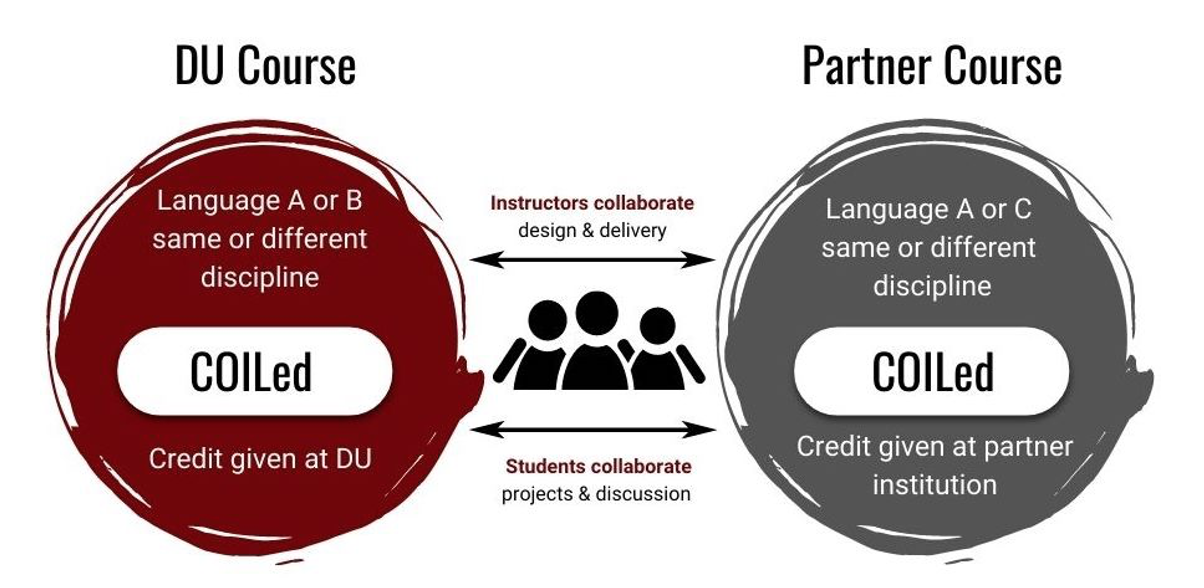
COIL incorporates global learning through access to multiple perspectives using a co-constructed, collaborative syllabus, curriculum, or activity. Instructors and students from both institutions collectively provide a much larger knowledge and experience base for mutual learning. A core tenet of COIL is to rely on each other to co-create course expectations. Negotiating and co-developing the joint online format with another instructor can foster constructive and unique opportunities for student engagement. Remember that it is about learning from and about one another, in content, cultural learning and global competencies.
-
Why Should I participate in COIL as an instructor or student?
COIL is about intercultural and global learning.
- Students produce cross-cultural and/or trans-cultural knowledge as peer global citizens.
- Students' communities, experiences and voices are valued.
- Everyone confronts some biases about the world, themselves and others.
COIL is about engaging in:
- Active and applied learning.
- Authentic projects and interactions.
- Collective decision-making and problem-solving with a purpose.
COIL is about student success.
- Students leverage global team-based learning and project-based learning.
- Students practice critical digital literacy, conflict, and time management.
- Students develop 21st century global workforce skills and global citizenship.
Examples of COIL at DU
HOSP 2360 - Managing a Restaurant Business with Maastricht University, Netherlands
Partner Institution: Maastricht University, Netherlands.
Discipline: Hospitality Management.
FSEM 1111 - An Introduction to Mathematical Modelling with Universidad del Desarrollo
RLGS 3893 - Buddhism and Social Justice with Lund University
LDRS 3000 - Leadership Ethics with Technological University of Dublin
Partner Institution: Technological University of Dublin, Ireland.
Discipline: Leadership Studies.
ASEM 2500 - Migration Politics with Lund University
PLSC 2660 - Feminist Political Thought
Spanish 1003 -Beginning Spanish/English
Partner Institution: university of Blearic Islands, Spain.
Discipline: Center for World Languages and Cultures.
SOWK 4903 – Photovoice as Intervention and Research Methodology
POLI 3290– Migration Politics
FSEM 1111- Food Politics
What's COIL
Meet The COIL Team
| Casey Dinger Executive and Academic Director for Internationalization |
| Leasa Weimer Director for Global Partnerships |
| Leslie Cramblet Alvarez Assistant Vice Provost, Director of the Office of Teaching and Learning |
| Lexi Schlosser Faculty Developer of Online Learning |
| Lul Yusuf Graduate Assistant |
Resources
Partner with us
Are you a faculty member at DU or faculty/COIL coordinator at any other institution and would like to partner with us? Fill out this survey.
Learn more about COIL
Want to learn more about COIL at DU and designing a COIL course? Check out this free online course.